

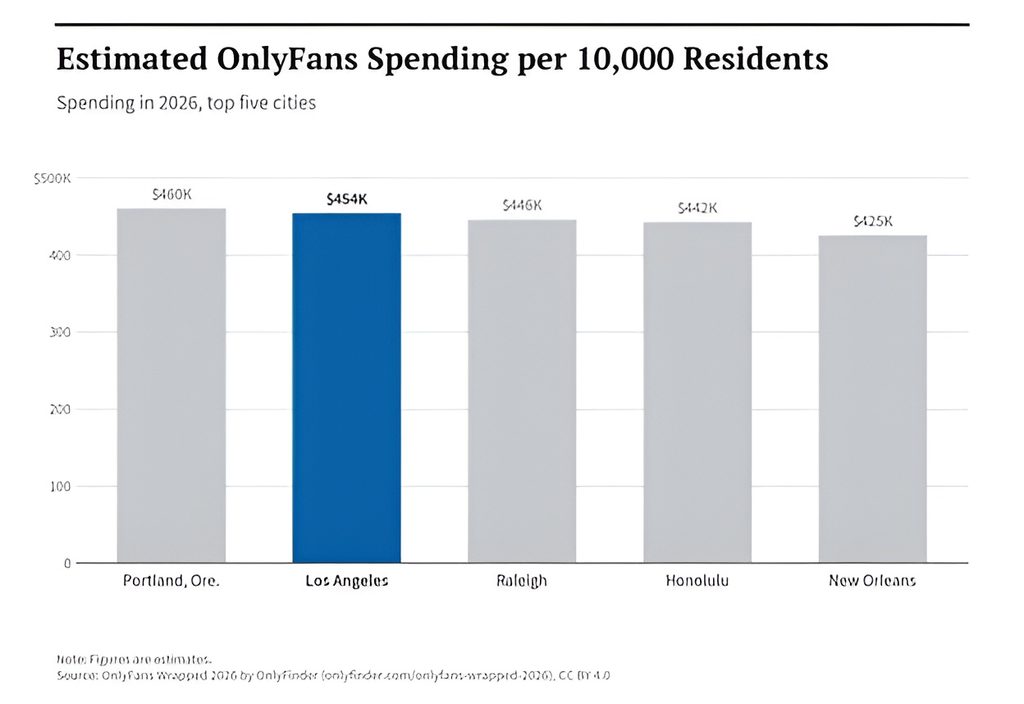
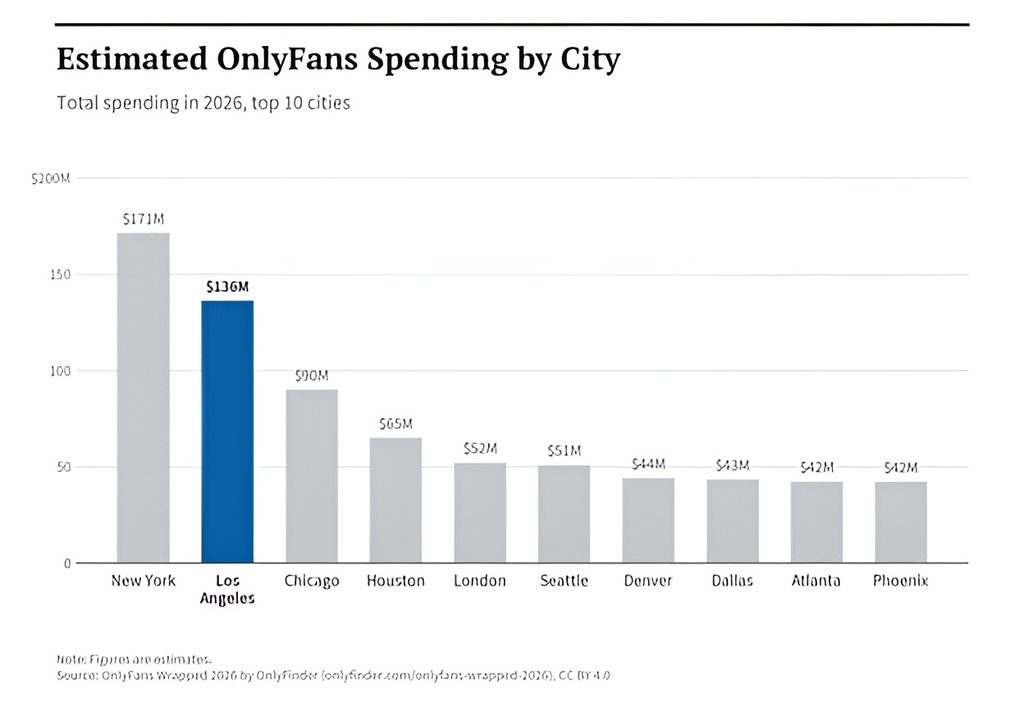
Los Angeles spent $134.8 million on OnlyFans last year, according to OnlyFinder’s OnlyFans Wrapped 2026, released last month. That’s second in the world in raw dollars, behind New York. It’s also second in spend per 10,000 adults at $449,557, behind Portland. No other city finishes in the top two on both lists.
Portland tops the intensity ranking at $455,291 per 10,000 adults, but its total spend is a fraction of LA’s. New York leads in total dollars with a much lower per-adult rate. London and Sydney spend big in total but at modest rates. LA trails Portland on intensity by $5,734, about 1.3%.
The per-person math shows how the money is spread per city. LA’s numbers imply roughly 3 million adults spending about $45 each per year, or around $3.75 a month. That’s less than half of one $9.99 subscription per adult, so the spending is almost certainly concentrated among a smaller group of subscribers paying for multiple creators, tips and pay-per-view.
The totals, on the other hand, are easier to understand. At $134.8 million, LA outspends 208 of the 213 markets in the report. That’s 3.3 times all of Argentina ($40.4 million) and four times Norway ($33.2 million). It works out to about $369,000 a day. LA accounts for 2.8% of America’s OnlyFans spend, and America accounts for 62% of the world’s, roughly $4.82 billion of a $7.8 billion global total.
The growth is what really stands out for Los Angeles. LA’s per-adult spend rose 14.09% in a year, from $394,044 to $449,557, an extra $55,513 per 10,000 adults. The median growth rate among ranked cities was under 9%. If LA repeats this year’s pace and Portland grows at the median, LA takes first place in next year’s edition.
The rest of California doesn’t keep up. The state as a whole spends $199,598 per 10,000 adults, so LA’s rate is 2.25 times the state’s. San Francisco, home to much of the payment infrastructure behind platforms like OnlyFans, spent $24.5 million, less than a fifth of LA’s total. San Diego ranks second in the state, about $100 million behind LA.
There’s a reasonable explanation for LA’s lead. The city has spent a century building America’s attention economy: studios, talent agencies, creator houses, and companies that design subscription products for a living. A population that understands how content gets made may be quicker to treat paying a creator as normal. The business of watching people who agreed to be watched has shrunk from a studio lot to a ring light, and LA still buys more of it than almost anywhere.
A note for skeptics: these are modeled figures. OnlyFinder runs a network of sites built on OnlyFans-related search traffic. The report starts with the audited filings of Fenix International, OnlyFans’ parent company, for its most recent completed fiscal year, then estimates each city’s share of national spending from search volume on an income-weighted basket of keywords. Cities need at least 200,000 adults to qualify for the per-adult rankings. Nothing beyond the underlying corporate filing was independently audited, and the figures are estimates, not a live tally.
Even with those caveats, LA’s position is hard to dismiss. It is the only city near the top on both intensity and volume, and it’s growing faster than almost everyone around it. With a $5,734 gap and a 14% growth rate, how much longer does Portland hold first?
