

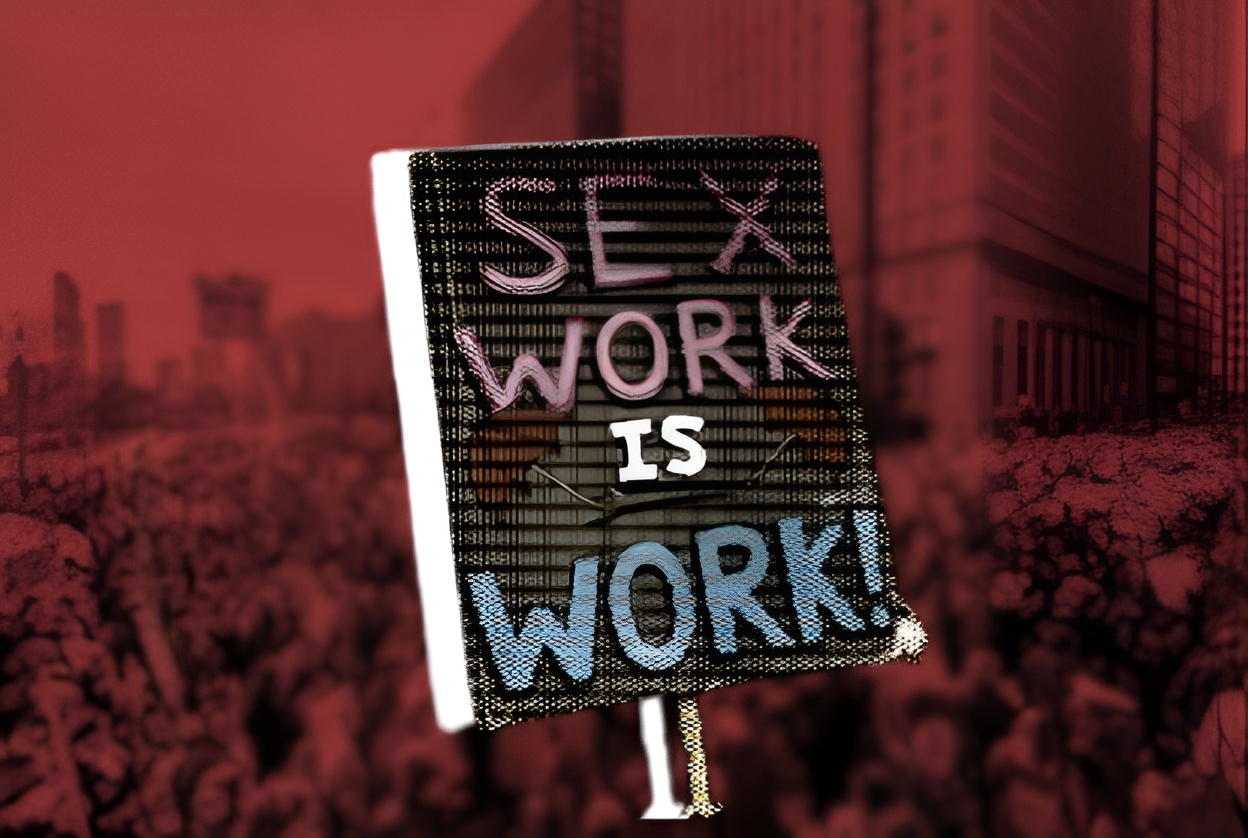
It didn’t garner splashy headlines. There was no flashy press conference, no legislation, no court ruling. But there was a massive breakthrough for sex workers in the United Kingdom last month. Quietly, a room full of trade unionists in Brighton voted to back the decriminalization of sex work, and the broader UK labor movement went on record agreeing with them.
At the annual TUC LGBT+ Conference held June 26-27 in Brighton, a motion brought by the performers’ union Equity passed with the support of the Trades Union Congress itself, seconded by the Bakers Food and Allied Workers Union. The motion called on the TUC to support unions in organizing LGBT+ sex workers, promote union contracts and health and safety standards for that community, and campaign for the full decriminalization of sex work as a matter of LGBT+ workplace safety and trade union equality.
Sex work is work. A union said it. A labor movement backed it. And while that may not feel like the same category of news as a Supreme Court ruling or a parliamentary vote, the ground shifted.
Smashyn Monroe, Co-Chair of Equity’s LGBT+ Committee, made the case from the floor with the kind of clarity that tends to get lost in more politically cautious settings. “As unions, it is our responsibility not to decide whose labor is morally acceptable,” Monroe said. “Our responsibility is to protect workers. Full stop. We do not improve safety by pushing people to the margins. We improve safety through organization, representation, and decriminalization.”
That framing is important. The debate around sex work policy has too often been structured as a moral question dressed up as a safety argument, with criminalization presented as protection when the evidence consistently shows the opposite. Criminalizing sex work doesn’t stop it from happening. It pushes it underground, making it harder for workers to screen clients, report abuse, or access legal protection. And it makes the most vulnerable workers – trans people, migrants, those doing survival sex work – exponentially more exposed to violence and exploitation.
“Criminalization does not stop sex work from existing,” Monroe said. “It simply makes workers more vulnerable to violence, exploitation, and abuse. Union protection, collective bargaining, and open support save lives.”
The motion specifically acknowledged that a significant number of sex workers engaged in performance work are LGBT+ workers, including trans and non-binary performers. This isn’t incidental, it reflects the economic reality that LGBT+ people, particularly trans people, face higher rates of economic marginalization and workplace discrimination, and the fact that the creative industries have always had significant overlap with sex work at their edges. Equity, which represents performers, artists, and creative workers, is not a fringe organization making a radical argument. It is a mainstream labor institution saying that the people in its membership who do this work deserve the same protection as anyone else.
The motion calls for decriminalization, not legalization, which would create a regulated but state-controlled framework. This is the model that sex-worker-led organizations consistently advocate for because it’s the one that actually keeps people safer. It removes the criminal cloud from consenting adults and allows workers to report harm without fear of arrest. It also enables client screening, collective organizing, and access to legal recourse when something goes wrong. Basically, it treats sex work as labor rather than as a crime requiring management.
For OnlyFans creators and digital sex workers specifically, this kind of institutional backing matters even if it doesn’t immediately change any law. The decriminalization of sex work shapes how platforms treat creators, how banks handle their accounts, how payment processors set policies, and how governments frame their regulatory approaches. Every piece of infrastructure is downstream of cultural and political consensus about whether this work is legitimate. When a union says it is, and the TUC backs that position, the consensus moves. Slowly and imperfectly, but it moves.
Just last year at Equity’s annual conference in Durham, members voted to actively encourage artists in performance work allied to sex work to join the union, explore how to better facilitate unionization through contracts and minimum standards in performance spaces, and work with sex-worker-led organizations toward full decriminalization. Now the TUC is building on that foundation.
Every time a union, a party, or a professional organization says sex work is work, the next institution finds it slightly easier to say it too. The TUC made it easier, and that’s not nothing. In fact, in a policy environment making things increasingly harder for this community, it’s quite a lot.