

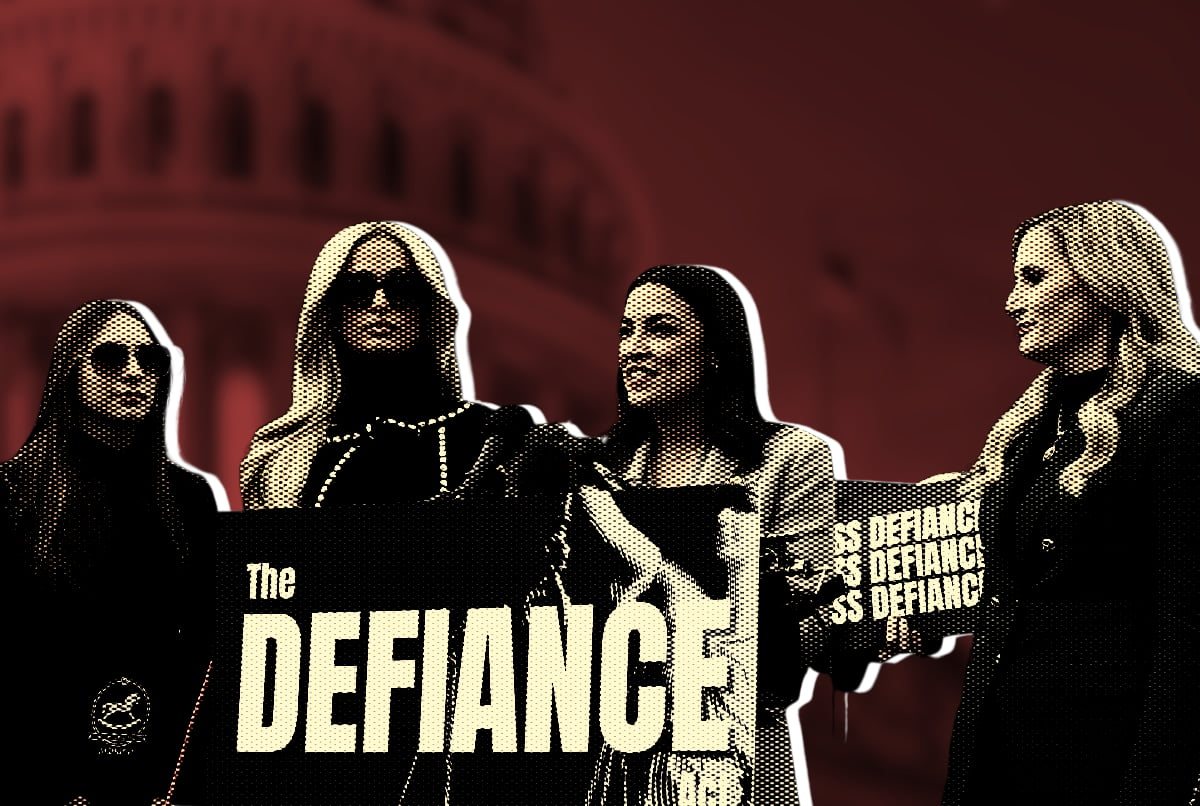
Paris Hilton returned to the steps of the U.S. Capitol on Tuesday with a simple message to House leaders: bring the Defiance Act to a vote. Standing alongside Rep. Alexandria Ocasio-Cortez (D-NY) and Rep. Laurel Lee (R-FL), Hilton pushed a bill that would let victims of sexually explicit AI deepfakes sue the people who make and spread them. The Senate has passed it twice, most recently by unanimous consent in January 2026. In the House, it has never gotten a vote.
The Defiance Act, short for Disrupt Explicit Forged Images And Non-Consensual Edits Act, would create a federal civil right to sue. Victims could go after anyone who creates, shares, publishes, solicits, or threatens to distribute sexually explicit deepfakes without consent. They could also recover legal costs and ask courts to order the content removed.
There have already been some laws put in place around non-consensual intimate images. The Take It Down Act, signed in May 2025, made certain types of images, including AI-generated ones, a federal crime and requires covered platforms to remove them, plus known identical copies, within 48 hours of a valid request. Sen. Ted Cruz introduced it after a Texas case in which an Instagram photo of 14-year-old Elliston Berry was edited to make her look nude and then circulated on Snapchat. But this law relies on federal prosecutors and offers no civil remedy for victims. Hilton has said current federal law sometimes “doesn’t work.”
Hilton’s argument is personal. She has said a private recording was released without her consent when she was 19, and now argues that AI has made that kind of violation infinitely scalable. “Somebody can literally just take an innocent photo and turn it into some explicit photo or video,” she said, adding that it’s happening to millions of women and children who have no one to protect them. In her work as chief advocacy officer at the digital identity firm Loti AI, she says the company found more than 100,000 explicit deepfakes of her and helped remove more than 60,000. “I’m very fortunate that I have a team of lawyers,” she said. “But a lot of these young girls and women don’t have that support.”
She also pointed to teenagers. “There’s girls who are teenagers in school. This is happening to them, and some of them are taking their own lives,” Hilton said. At a press conference, she claimed 83 of the 156 women serving in the 119th Congress have sexual deepfakes online right now, and said 50 million people have been victimized by this kind of digital abuse.
Ocasio-Cortez, who has said she’s been a target herself, framed it as bigger than any one person. “There are young women, girls, kids even” affected, she said, calling it a form of sexual abuse and arguing that victims deserve the right to go after predators in court. She made the case on Fox News with Lee and Hilton.
The bill is mostly bipartisan. The Sexual Violence Prevention Association, which helped write it, delivered letters Tuesday to House Speaker Mike Johnson and Majority Leader Steve Scalise asking for a floor vote. The group says the bill has 117 endorsements, including Microsoft and Snap, and in June 2026 OpenAI became the first AI company to back it. In the House, it has 70 cosponsors, split evenly with 35 Democrats and 35 Republicans.
So why hasn’t it moved? Ocasio-Cortez introduced the House version in May 2025, and it was referred to the Judiciary Committee, where it has sat since. Johnson told reporters in September the bill was “good policy” but that the House hadn’t built consensus. There was speculation that some Republicans were reluctant to hand Ocasio-Cortez a win before the midterms, but those have come and gone and still no movement on the Defiance Act.
But time is ticking. If the House doesn’t act before this Congress ends, supporters have to start over in the next one, where Democrats are projected to hold a majority. For creators and others targeted by fabricated images, a takedown law helps once an image is up, while a right to sue is meant to deter the person who made it.
Hilton put the question directly to lawmakers: “Will you allow this to continue to happen to your colleagues?” Given a unanimous Senate, a bipartisan cosponsor list and a corporate endorsement from the AI industry itself, what exactly is the House waiting for?